O'BRAIN Research Line
Obesity, Eating Behavior,
Diet and Decision-Making
At the O’BRAIN Lab, we explore how the brain’s motivational and regulatory systems shape the ways people engage with food and navigate an increasingly complex eating environment. Our work brings together mind, behavior, and biology to uncover the patterns that guide everyday choices and long-term habits. We aim to illuminate pathways to support healthier decisions and more resilient lives.
Learn more about our projects at the O’BRAIN Lab:
About Our Research
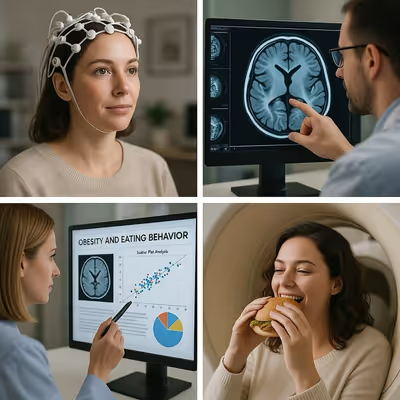
We at the O'BRAIN Lab believe that multiple individual factors determine what and how much we eat and how susceptible a person is to develop obesity. Individual differences in behavior, governed by cognitive processes and traits like reward-sensitivity, reinforcement learning or executive functions, might make it more difficult to navigate in today's complex obesogenic environment. Eating and choice behavior can be acquired and shaped throughout the lifespan but are presumably influenced by underlying genetic predispositions as well. With our research, we aim to identify neurocognitive profiles that can explain what factors contribute to certain eating habits on the individual level. Ultimately, our research will help prevent the progression and treatment of maladaptive eating habits and obesity by developing individualized intervention strategies.We tackle this ambitious goal by drawing upon multiple scientific disciplines such as biology, psychology, neuro- and cognitive sciences, medicine, nutritional sciences, and mathematics. Since 2019 our lab is based at the University of Helsinki, Finland and we have a close collaboration with the Max Planck Institute for Human Cognitive and Brain Sciences in Leipzig, Germany.
Current Research Portfolio
The Laboratory's Pursuit of Foundational and Applied Breakthroughs
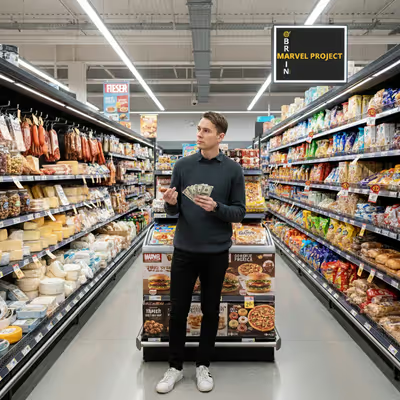
Modern Alimentation effects on Reward, behaViour and the gut Environment in the finnish dietary Lifestyle (MARVEL)
Description:
Previous studies suggest that there are unconscious signals to the reward system that influence food choice and that are created and maintained as a consequence of our modern, obesity-promoting environment. To confirm and extend these results in a Finnish sample, we aim to investigate macronutrient combinations such as carbohydrates and fat food items along with food processing and examine their effects on food motivation. Using a series of food questionnaires, a behavioral task as a proxy for food reward, and functional magnetic resonance (fMRI), we hope to move closer to understanding the effects of modern diets on human eating behavior in individuals with a wide range of BMI.
Long-term Understanding of Mechanisms Involved in Neurocognitive Alterations following breast cancer (LUMINA)
Description:
While many people know that breast cancer is the most common cancer among women, fewer realize that survivors often experience lasting problems with memory, focus, and thinking clearly. These cognitive difficulties can vary from person to person and may be influenced by individual factors such as age, anti-cancer treatments, or prior health. In this study, we are using online tools to track brain function and overall quality of life. We are comparing breast cancer survivors with women who have no history of cancer to better understand these changes. In a second part of the study, some participants will try a gentle brain stimulation treatment that can be done at home. This non-invasive, flexible approach may help improve mental clarity without the need for hospital visits. Our goal is to learn more about how the brain recovers after cancer and to develop effective, personalized ways to support survivors in everyday life.
neuroPOD — Deep cognitive phenotyping for individual variability in obesity
Description:
Obesity is a highly heterogeneous condition, with substantial differences between individuals in cognitive, behavioral, and neurobiological characteristics. To capture this diversity, we use neuroPOD, a comprehensive deep cognitive phenotyping online tool designed to assess a wide range of cognitive and behavioral traits relevant to obesity. The tool captures multiple neurocognitive dimensions, including general cognitive functioning and self-monitoring processes, sensitivity to reward and internal bodily signals, emotional experiences, as well as everyday behaviors related to eating and sleep. By providing a rich, multidimensional profile of these interrelated processes, neuroPOD offers a foundation for exploring individual variability in obesity. In the longer term, this approach may support more personalized prevention and treatment strategies and contribute to a more nuanced understanding of obesity as a complex and multifaceted condition.
Shared and Differential Neurocognitive Mechanisms in Obesity and Binge Eating Disorder from Adolescence to Adulthood
Description:
In collaboration with the IFB AdipositasErkrankungen in Leipzig, we investigate flexible goal-directed decision-making processes in a cohort of adolescent and adult obesity patients with and without BED. In this way, we want to systematically differentiate the neurocognitive mechanisms of obesity and BED in adolescence and adulthood. We use functional magnetic resonance imaging (fMRI) to probe two crucial components of goal-directed decision-making: reversal learning and working memory updating and maintenance. Because alterations in dopaminergic signaling have previously been implicated in goal-directed decision-making as well as BED and obesity, we also investigate whether these neurocognitive measures are associated with genetic and imaging proxies of prefrontal and striatal dopamine function.

The association of dietary fat and sugar with cognition
Description:
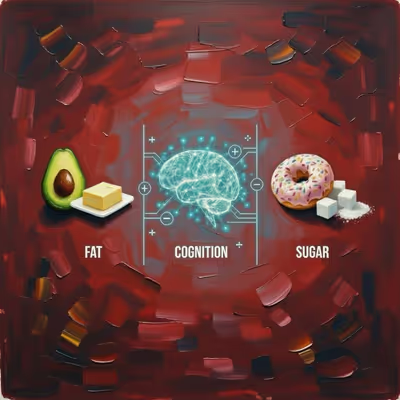
Building on findings from animal studies we are interested in whether a higher intake of saturated fats and refined sugar is associated with differences in dopamine-related cognition. We recruited participants based on their self-reported fat and sugar intake, grouped them into low and high consumers and compared their performance on five different cognitive tasks – two of which were performed in the MRI scanner. Additionally, two genetic variants related to dopamine were analyzed and linked to dietary intake and cognition.
The association between a high-fat and high-sugar diet and neuromelanin concentration
Description:
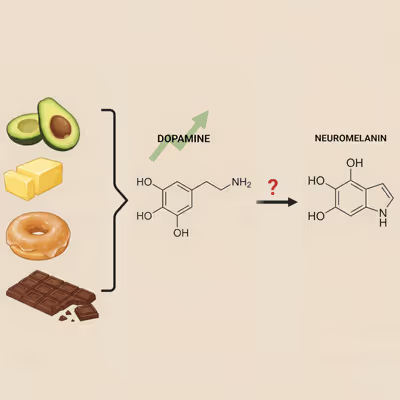
Synthesized from dopamine, neuromelanin accumulates with age. Concentrations of neuromelanin have been shown to correlate to dopamine release. Findings in animal studies suggest that following a diet high in fat and sugar induces dopaminergic changes. However, how these alterations relate to long-time changes within the brain’s dopaminergic pathways is not known, and therefore we investigate whether a higher intake of saturated fats and refined sugar is associated with differences in neuromelanin concentration in humans. We do this using quantitative susceptibility mapping (QSM), an MRI technique that is sensitive to paramagnetic substances.
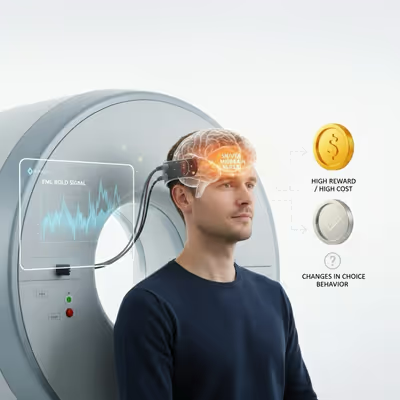
Does closed loop neurofeedback from SN/VTA impact on cost-benefit decision-making?
Description:
This collaboration project with the Department of Economics at the University of Zurich employs functional magnetic resonance imaging (fMRI)-based neurofeedback from human SN/VTA midbrain nuclei. Based on their assumed role in motivation, this project investigates the link between (voluntary) BOLD signal fluctuations within these areas and changes in cost-benefit decision-making.
66 days to form a habit?
Description:
In 2010, a breakthrough study by Lally and colleagues titled How are habits formed: Modeling habit formation in the real world found that on average it takes people 66 days to form a healthy habit. This study has been cited more than 2000 times, inspired a line of research into real-world habit formation, and influenced public occupational health, business economics, and science technology around the globe. In an international cooperation with the universities of Amsterdam, NL, Cambridge, UK, and Konstanz, GER and led by Dr Sanne de Wit we aim to replicate the study’s finding and extend it to a broader population.

Resources
Selected datasets and materials maintained by the O’BRAIN Lab.
FinnFoodPics: Image database of food items for the study of eating behaviors in residents of Finland(Kanyamibwa et al. 2025).
Description
72 food images (i.e., snacks) each in ten different portions (40, 80, 120, 160, 200, 240, 280, 320, 360 and 400 kcal), classified into three macronutrient categories with one group containing high amounts of calories predominantly from carbohydrates (Carbohydrate category), one with calories predominantly from fat (Fat category), and the third group with items containing a high percentage of calories from both carbohydrates and fat (Combo category) (Fromm et al., 2021). Aside from the 720 images, the database contains nutritional information of the food item per 100 g as well as the specific portion size of 120 kcal. In addition, visual image properties (Blechert et al., 2014) and subjective food ratings from a representative sample of residents of Finland are provided for the 120 kcal portion.
We also included the source of the items (for example, Lidl supermarket), brand names, commercial prices at the time of purchase, and NOVA classification based on Monteiro and colleagues (Monteiro et al., 2010, 2019).
Details
- Food characteristics: energy density (kcal/g), protein (g/120 kcal), fat (g/120 kcal), carbohydrates (g/120 kcal), fibre (g/120 kcal), salt (g/120 kcal), sugars (g/120 kcal), saturated fat (g/120 kcal), price (€/120 kcal), NOVA classification.
- Food ratings: liking (% of scale), familiarity (% of scale), perceived healthiness (% of scale), expected satiation (% of scale), frequency of consumption (days/month), estimated energy density (% of scale), estimated energy content (kcal).
- Visual properties: visual area of food (cm²), R/G/B values, brightness, within-object contrast, complexity (edge detection), spatial frequency.
Access Form
- If you happen to encounter other interested parties, kindly share this webpage or our preprint (Kanyamibwa et al. 2025) with them to ensure they receive the most up-to-date version of our database.
- Your data is handled with the utmost confidentiality. It remains secure and accessible only by O’Brain Lab members, safeguarded against unauthorized access. Its sole purpose is to gather insights on the parties interested in our image database.
Frequently Asked Questions
Can I participate in any of research projects?
Yes, you can participate in any of the research projects listed. Please refer to the recruitment section for more details.
Can I contribute to the research projects?
Certainly! we are always looking for passionate individuals to contribute. Please share us your research interests and background. Please check out "work with Us" page for more details.
Are the datasets and codes available?
All related information are available in pre-registration forms on open sciece framework. Datasets are not open access, yet you are welcomed to contact us for further inquiry. .
Reach out to us
Have questions about the projects? Feel free to contact us.
Email us
obrainlab@gmail.com
Visit us
University of Helsinki, Department of Psychology, Haartmaninkatu 3, PL 21, 00014 Helsinki, Finland
Follow us on Bluesky